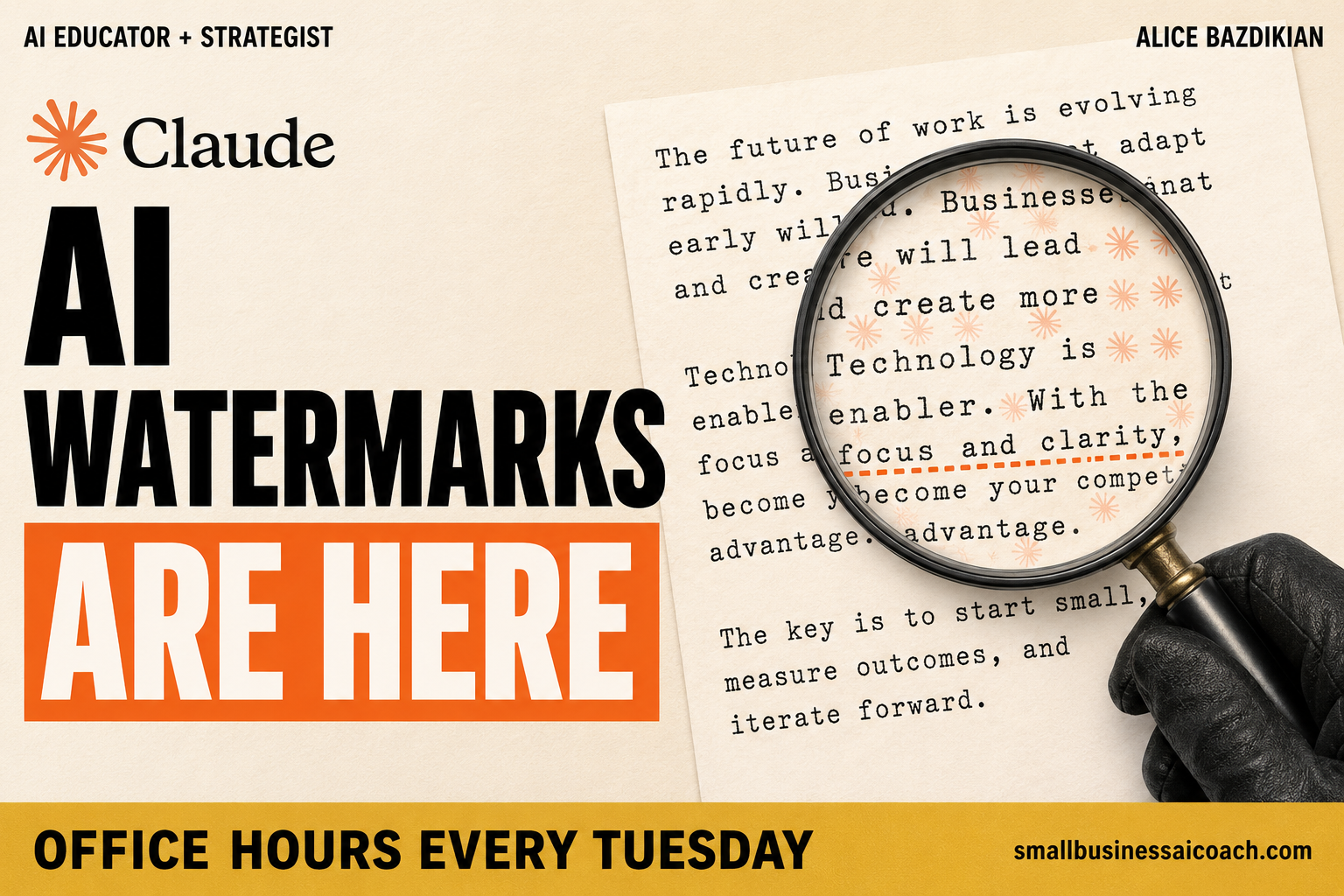
If you use Claude anywhere in your business, the text it helps you produce now carries an invisible mark. Not a logo, not a footer, not weird characters you can delete. A mark woven into the words themselves. It survives copy and paste, and it may survive editing.
Why this matters for you
Detectors are coming, and employers, schools, and clients are going to point them at your work. A positive result only proves Claude touched a document, not that AI wrote it, but most people will not know the difference. If a client ever questions an invoice, a proposal, or a deliverable, you want to understand exactly what a watermark can and cannot prove before they do.
How tomorrow gets better
By the end of this post you will know what actually changed, why every "just remove the watermark" trick you have seen online fails, and the simple provenance habit that lets you prove your work is yours, no detector required.
Here is everything we actually know, everything we do not, and what to do about it, without the panic.
The confirmed facts so far
- Anthropic says new Claude models launched in the EU on or after August 2, 2026 support marking from day one. Older models are being updated retroactively.
- We have already been living with watermarked models for roughly two weeks.
- The detector and the technical documentation are still coming. Nobody outside Anthropic knows the exact method yet.
- This is a real change. It just needs the caveats left attached.
Two different marks, not one
Anthropic is adding two separate systems, and most of the confusion online comes from mixing them up. One mark travels in the words. One travels with the file.
| The mark | Where it lives | How sturdy it is |
|---|---|---|
| Invisible text watermark | Woven into the generated text itself, applied at the model level. The same supported model marks output from Claude.ai, the API, Claude Code, Cowork, and supported cloud partners. | Moves with the words when you copy and paste. May survive some editing. This is the interesting one. |
| C2PA provenance metadata | Attached to supported image files (SVG, PNG, JPG) as signed metadata. | Travels with the file, but normal exports, resaving, and screenshots can strip it. Less interesting, and strippable. |
How the text watermark (probably) works
The exact method is undisclosed until Anthropic publishes its technical specifications. But it is highly likely a statistical watermark: as the model generates, it slightly adjusts which plausible next word it chooses, shifting the statistical distribution of the text in ways a detector can later recognize as Claude-generated.
This is not crude word insertion. It is small nudges across the whole passage, largely imperceptible to human readers. The signal lives in the combination of words across sentences and paragraphs. It is not invisible Unicode, extra spaces, or weird formatting characters. That would be trivially easy to strip out, and it is not how this works.
Google has publicly documented something similar with SynthID Text. That does not mean Claude uses Google's method. But if it is similar, one fact matters a lot: nobody has reliably broken SynthID since 2024. So the people saying "lol I'll just remove it" are talking nonsense.
The removal "hacks," and why most of them fail
The internet is full of confident removal tricks right now. Here is the honest scorecard.
| The "hack" | Verdict | Why |
|---|---|---|
| Paste as plain text / Notepad | Fails | The mark is in the composition of the text, not the formatting. |
| Print it out and scan it back in / OCR | Fails | Same reason. The watermark is in the sequence of ordinary word choices. |
| Manually retype it | Fails | Typing the same words preserves the same sequence, just slowly. |
| Ask another AI to "remove the watermark" | Fails | No such magic button exists. Other models do not know how the watermark is composed. |
| Heavy rewriting, paraphrasing, or translation | Partly works | A real, known weakness of statistical watermarks. Google says thorough rewriting can greatly reduce SynthID's confidence. But it alters meaning, introduces errors, flattens your voice, and absolutely mangles code. |
| The scrubbing attack: insert a junk word between every real word, then strip the junk out | Unknown | A real, documented attack class that breaks the statistical sequence. Nobody knows yet how well it works against Claude's implementation. |
Notice the one "hack" that partly works raises the obvious question: if your plan is to rewrite Claude's output with a cheaper model anyway, why pay for Claude in the first place?
Anyone promising a definitive removal trick today is guessing or selling something. We will not know what is possible until the detector and the technical specs ship.
No, Anthropic does not own your work now
The loudest myth going around: the watermark lets Anthropic claim copyright or co-ownership of anything Claude touches. Flat wrong. The watermark is a provenance signal. Nothing in the mechanism transfers copyright, assigns ownership, or gives Anthropic a slice of your business.
The best metaphor I have seen: a hammer does not claim ownership of the house it built. Photoshop leaves metadata on your images without Adobe owning your photos. The mark can say "Claude processed this." It cannot say "Anthropic owns this."
This is global, not just a Europe thing
You may be thinking, "I'm not in Europe, this doesn't affect me." Wrong, sorry. Article 50 of the EU AI Act applies to providers outside Europe the moment their systems or outputs reach the EU market. Being based in California does not end the analysis. It is where your customers are that matters. And the EU has real teeth: US companies have paid about $5 billion in GDPR fines since 2019.
Anthropic could have built a Claude-for-Europe and a Claude-for-everyone-else. It chose one worldwide rollout, because maintaining split models, servers, and product lines would be mad and expensive. The carrot is EU market access. The stick is fines up to 15 million euros or 3 percent of worldwide revenue. Revenue, not profit.
We have seen this movie before. The EU required USB-C, and Apple replaced Lightning globally rather than manufacturing a separate European iPhone. GDPR gave the entire world cookie banners. It is the dinner-party rule: when guests have different dietary restrictions and you can only make one dish, you cook for the fussiest eater. The EU is the fussy eater.
Timeline: Article 50 has applied since August 2, 2026. Older systems already on the market get a grace period to December 2, 2026, and after that the exposure gets very real.
And it is not just Anthropic. Google has used SynthID for years. OpenAI already watermarks images and audio and has publicly committed to extending provenance signals to all modalities, including text. Meta, Microsoft, and Mistral signed the provider section of the EU code. All the Western labs are falling in line except xAI. Claude is only the current punching bag because Anthropic explained its rollout first.
A mark does not mean Claude wrote it
This is the part that is going to ruin some people's weeks, so read it twice. You can write an entire document yourself, ask Claude to proofread it, and it comes back watermarked. Translate your own article: watermarked. Summarize your own meeting notes: watermarked. Claude touched it. Claude did not necessarily author it.
Anthropic's own wording is that a detected mark means the content may have been processed by Claude. It cannot tell you who had the idea, how much a human wrote, whether the facts are correct, or whether anybody cheated. Treat the mark like a fingerprint on a murder weapon: it proves contact with the tool, not who did the deed. It is not an authorship certificate.
The danger is that employers, schools, and clients will treat one probabilistic signal as proof. "You used AI, I'm not paying you." "You lose your grade." If your business produces content, proposals, or reports for clients, that conversation is coming, and you want to be the person in the room who understands what the signal actually means.
One more wrinkle: Article 50 itself says the watermarking obligation does not apply when the AI performs an assistive function for standard editing and does not substantially alter the input. If Anthropic marks everything Claude touches, including light grammar passes, they may be doing more than the law requires. That is unconfirmed until the specs ship, but it is a real open question.
And no mark does not mean human, either
The opposite conclusion is just as shaky. A detector may find nothing because the text came from an older unsupported Claude model, the passage was too short, somebody heavily rewrote it, the file metadata got stripped, or a different AI entirely wrote it.
Which creates a perverse incentive: the honest owner who used Claude for a grammar pass gets flagged, while the person who deliberately works around the detector sails through. In a world where everything else flags as AI, the marginal gain from cheating just went up. Cheaters prosper.
The open questions nobody can answer yet
Two concerns from the technical crowd are worth keeping an eye on. First, quality: it is hard to imagine watermarking not affecting output in highly constrained work like poetry with precise meter, or code, where nudging word probabilities even slightly can break things. Google reports no detectable quality loss for SynthID, but that is evidence about SynthID, not about Claude's undisclosed method.
Second, who really benefits: the internet is filling with AI-generated content, and the internet is also the main training source for new models. Watermarks let the labs identify and exclude synthetic text from future training data. It is also why Anthropic paid millions for clean human data and destroyed millions of physical books: pre-2022 content is guaranteed non-AI. The EU takes the blame, the labs get a cleaner data filter.
And here is the full list of what we still do not know: the exact watermarking method, which models are covered, the minimum passage length, the confidence thresholds and false-positive rates, how robust it is to attack, and the detector launch date. Anybody claiming they can give you a definitive Claude verdict today is talking nonsense.
What to do now: keep your own evidence
Here is the practical takeaway for creators and business owners. Do not rely on a watermark to explain how you made something. If you may one day need to prove a piece of work is yours, start tracking provenance now. It costs you minutes and can save you a client relationship, a contract, or a reputation.
| The habit | What to do | Why it protects you |
|---|---|---|
| Record the tools you used | Note the model and product for each significant deliverable. One line in a notes file is enough. | You can state your process instead of guessing at it later. |
| Keep your source files | Save your original notes and messy first drafts. | The first draft is your best evidence of authorship. |
| Save the edit trail | Use version history in Google Docs, or dated folders. | It shows the human work between draft and deliverable. |
| Test your exports | Run a file through your normal export workflow and check it. | You learn what metadata survives and what gets stripped. |
| Give the history a home | Keep it all in a shared AI vault or one well-organized folder. | You are never reconstructing the story after an accusation. |
Knowing where content came from is becoming extremely valuable. The businesses that can calmly show their work will win the awkward conversations that are coming. The ones that rely on a detector's verdict, in either direction, are gambling.
Sources: Anthropic's rollout statements, Article 50 of the EU AI Act, and reporting by Kyle Balmer (AI with Kyle).