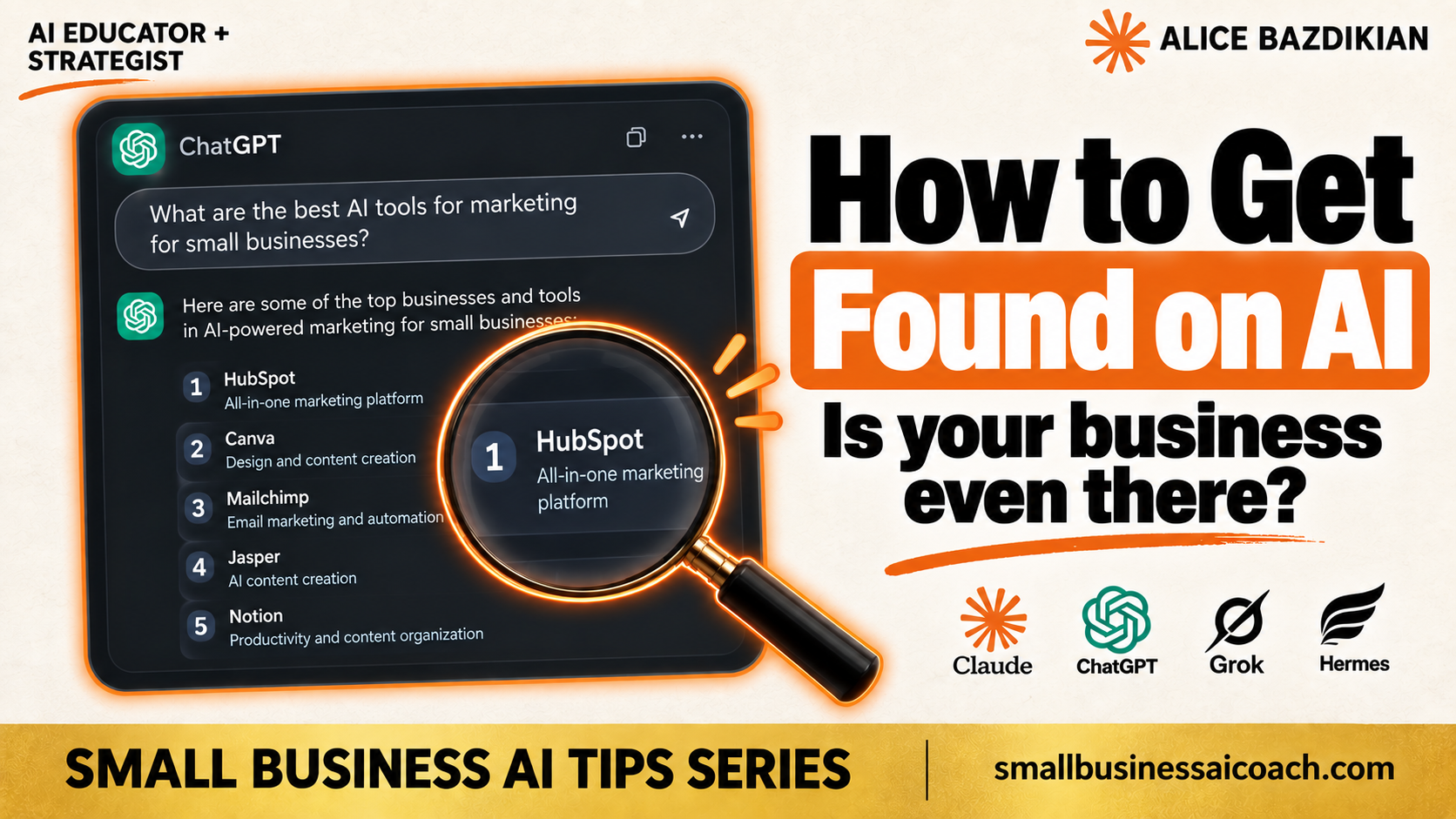
Type your niche into ChatGPT right now. Ask it to recommend the best business like yours in your area. Your name almost certainly won't come up, and that's not a Google problem.
It's a GEO problem, and right now most small business owners don't even know it exists.
What GEO Actually Is
GEO stands for generative engine optimization, and it's SEO for AI. Traditional SEO gets your website found by Google's crawlers and ranking algorithm. GEO gets your business surfaced when someone asks Claude, ChatGPT, or Perplexity for a recommendation, and a growing share of your potential clients are doing exactly that instead of typing a search into Google.
The businesses those platforms recommend aren't necessarily the ones with the best Google rankings. They're the ones structured so an AI can actually read, trust, and cite them.
Why this matters for you
AI search is a growing part of search, not a future trend. 51% of B2B software buyers now start their research in an AI chatbot more than Google, and 73% use one somewhere in the process (G2, 2026). On the consumer side, 37% of people now start their searches with AI instead of Google, and roughly half use AI search when making a purchase decision (McKinsey). You can rank on page one of Google and still be invisible to every one of those searches, because the two run on different signals.
How tomorrow gets better
Once you know what AI actually cites and why, you're not guessing anymore. You check your own visibility on a schedule instead of hiring an agency to babysit it, and every piece of content you publish is built to be the answer instead of getting overlooked in favor of it.
Step 1: Search the Way Your Clients Actually Search
You don't need a third-party tool to find out where you stand. You need to search the way your clients actually search, and look at what comes back.
- Write down the 3 to 5 phrases someone would actually type when they need what you sell. Not your business name, the problem you solve: "best [your service] in [your city]," or "how do I [the thing you help with]."
- Type each one into ChatGPT and Claude and ask for a recommendation.
- Check whether your name comes up. If it doesn't, look at whose does, and open a couple of the sources those answers are pulling from.
Most small business owners who do this for the first time don't show up at all. That's the real audit, and either Claude or ChatGPT can walk you through reading the results.
"I run [your business, one line]. Search for '[your phrase]' the way a potential client would, and tell me whether my business would show up in your answer. If not, look at the sources you'd actually cite, and tell me what's different about their content compared to mine."
Step 2: Match the Format AI Actually Cites
The sources that come up aren't random. AI engines have a strong, measurable preference for certain content shapes over others.
Listicles are cited more than any other format, beating how-to guides by roughly 7.6x across AI engines overall (Qvery, 2026). But it splits by platform and by query. Listicles dominate commercial "best of" questions. Claude specifically favors comprehensive, data-rich guides for informational questions, citing them at a much higher rate than a thin listicle covering the same topic.
| Question Type | Format That Wins | Example |
|---|---|---|
| "Best" / "top" questions | A ranked listicle | "Best bookkeepers in Montreal" |
| "How do I" questions | A comprehensive, data-backed guide | "How do I switch accountants mid-year" |
| Comparison questions | A structured side-by-side | "In-house bookkeeper vs outsourced" |
If your website is all short service-page copy and no actual content answering these questions, there's nothing for AI to cite. That's usually the real gap, not a missing schema tag.
Step 3: Fix the Gap With Claude or ChatGPT
This step is tool-agnostic. Claude Code, Claude Cowork, and ChatGPT can all do this work. Use whichever one you already pay for.
- Pick the query from Step 1 where you're weakest.
- Decide the format from the table above that matches it.
- Ask Claude or ChatGPT to draft that page or article, built around the real questions your clients ask, not around your business name.
- Publish it, then check for schema markup on the page. A listicle with structured
ItemListmarkup gets cited 3 to 5x more often than the same list with none (Qvery, 2026).
"Write a [listicle / comprehensive guide] answering '[your query]', in my voice, based on how I actually work with clients. Then add the ItemList (or Article) schema markup for this page so AI search engines can parse and cite it."
Claude Code can go further than this if you connect it to a live SEO data source via MCP (Model Context Protocol), which gives it real keyword and search data instead of relying on your conversation history. That's worth setting up once you've got a few of these pieces live and want to scale the research. It's not required to get started.
Step 4: Re-Check and Repeat
After you publish, re-run the same self-check from Step 1. Type the same phrases back into Claude and ChatGPT and see whether anything changed.
This isn't a one-time task. AI search platforms update constantly, and a citation you earn this month isn't guaranteed next month. The small business owners who stay visible are the ones who build this into a regular habit instead of doing it once and forgetting about it.
One-time fix
- Publish once, check once, move on
- Visibility quietly drifts as platforms update
- You find out you're invisible again the hard way
Ongoing practice
- Re-check your key phrases on a regular schedule
- Claude or ChatGPT drafts the next piece each time
- Your visibility compounds instead of decaying
What AI Visibility Actually Means for Your Business
When someone asks Claude or ChatGPT for a recommendation, the AI draws on the websites it can parse, trust, and cite. A well-structured, GEO-optimized site has a real chance of showing up in that answer. A site with no real content behind it has essentially none.
This isn't theoretical. It's a current, widening gap between businesses AI can find and businesses it can't, and it's fixable without a developer or an agency retainer. You need to search the way your clients search, match the format AI actually cites, and let Claude or ChatGPT do the writing.

Get the exact GEO setup inside the Small Biz AI Hub
The full walkthrough, the audit tools, and live weekly AI office hours where we work through your real GEO score together. Real people, real support, and discussions that are always ongoing. Free to join for a limited time.
Would you rather have it done for you?
Book a free AI diagnostic. In 30 minutes we find out where your AI visibility actually stands and what to fix first.