Do you know the difference between a skill and a plugin? What about an MCP and an API?
If you have been using AI for any length of time, you have heard the terms floating around. Skills. Tools. MCP servers. APIs. CLIs. It is a lot of vocabulary, and most of it sounds like it belongs to engineers, not business owners.
Here is what I see every week coaching entrepreneurs: most people, even the sharp early adopters, spend a long time in the shallow end before they ever wade into the water where the real leverage lives. Not because they cannot. Because nobody ever mapped it out for them.
So let me map it out. And it starts with one word: the harness.
The Harness, Not the Model
When AI feels limited to you, the model itself is usually fine. It is the harness that needs the attention.
Think of the large language model, the LLM, as the CPU in a computer. It ships from the factory able to execute a fixed set of instructions. But a CPU on its own cannot do much. It cannot store your files. It cannot show you anything on a screen. It cannot connect to the internet. For all of that, you need an operating system, like macOS or Windows.
An LLM is the same. On its own, it is constrained to whatever shipped from the factory, meaning its training data. By itself, it is just a text-completion engine. It does not know who you are. It cannot remember between chats. It cannot reach your tools, take actions, or run software.
"The harness is everything that wraps around the model and fills in those gaps. It is not one thing. It is a stack of layers, each adding its own capability."
That is the picture below: the model sits on one side, and the harness, your tools, your context, and you, feeds into it so it can actually do something useful.
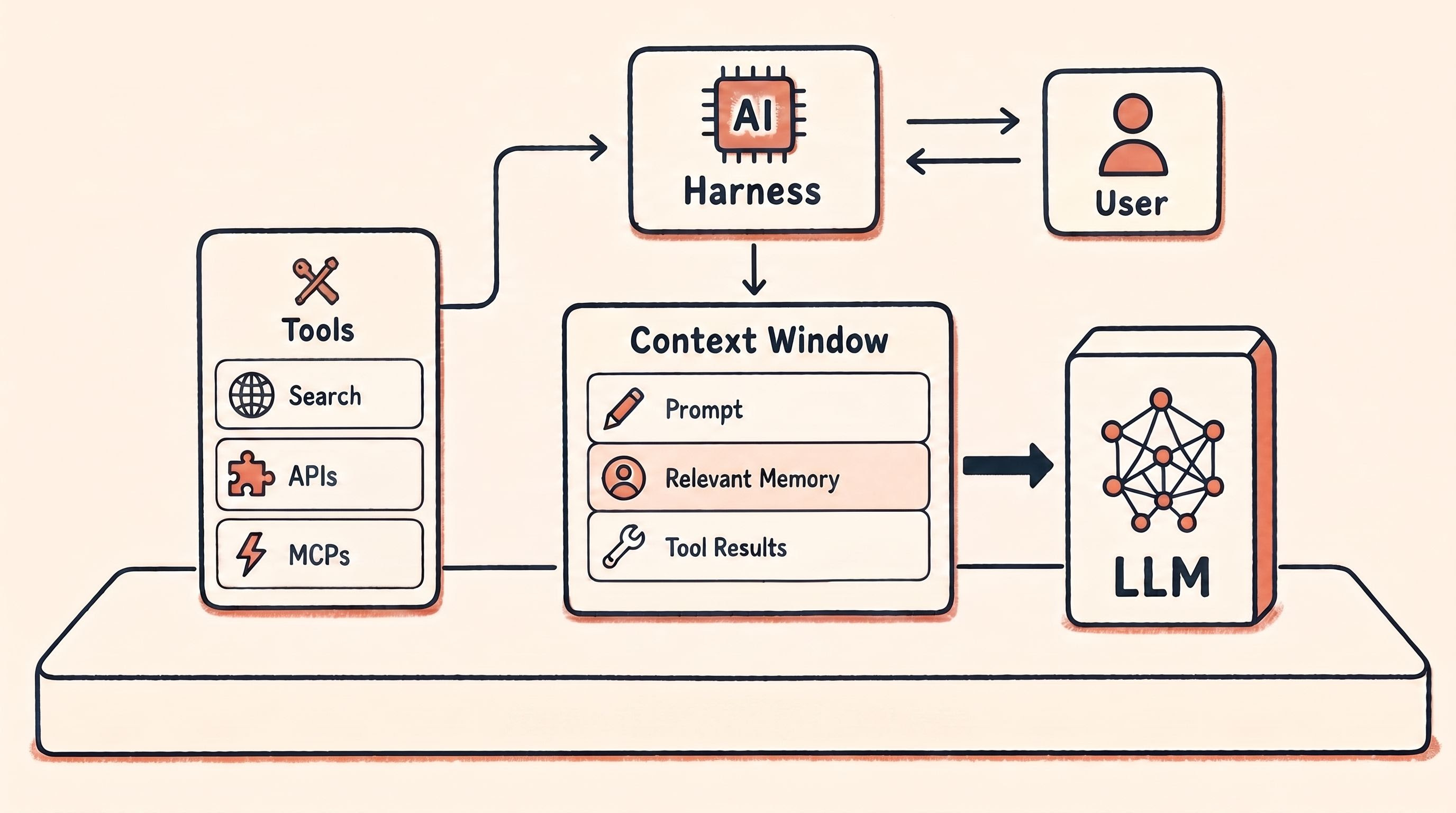
Picture It as a Ladder
Picture the harness as a ladder. Not a mountain you have to summit, and not a difficulty curve where every rung is harder than the last. It is just a way to see AI's layered capabilities, so you can spot which rung your work actually needs next.
The first few rungs are where a tiny amount of setup effort compounds into a much higher-quality AI experience.
Here is how I think about those early rungs: they are about giving the AI more of you. More context, more process, more reach. The model does not get smarter. Its IQ does not go up. But its EQ does, because it can finally understand you and meet your needs.
A prompt is what you type into the chat. Better prompts help. But the bigger shift over the last couple of years has not been about optimizing how you ask. It has been about optimizing what the AI has access to when it thinks.
Rung 1: Prompts
Everyone knows prompts. A prompt is what you type into the chat, and it is the rung you are already standing on.
The opportunity here is not to abandon prompts. It is to stop relying on them alone. Every rung above this one exists because a great prompt, typed fresh into a blank window every single time, still leaves the AI guessing about everything you did not say.
Rung 2: Custom Instructions
Custom instructions are the reusable context you should not have to keep retyping.
Every new conversation with ChatGPT, or any chatbot, is essentially a blank slate. Outside of memory, project files, or other saved context, it does not automatically know who you are, what you do, or how you prefer to communicate.
Custom instructions solve that by letting you fill in the blanks once. Your answers get added to the context the AI can draw on when it responds. So the conversation can reset, but your baseline context stays. That is efficiency you feel immediately.
Rung 3: Skills
A skill is a reusable playbook. It teaches the AI, most commonly Claude, how a person, team, or company does a specific kind of work, through instructions, metadata, scripts, templates, and examples.
A process you keep re-explaining becomes something the AI can simply follow. Think of it as an SOP, a standard operating procedure, except the AI is the one running it.
One note, because this word causes confusion. The exact boundary of a skill varies by platform, so it is not a universal standard. In ChatGPT, similar functionality shows up through Projects, Custom GPTs, memory, files, and instructions. And to be clear, a skill here does not mean a human career skill. It means a reusable process for the AI.
Rung 4: Plugins
You have probably used plugins long before AI entered the picture. In Photoshop. Maybe even in Minecraft. A plugin is, generally, a way to extend a system.
In the AI world, a plugin is a modular software component that lets AI agents connect with external systems, applications, and data sources. Here is the quick way to keep the related terms straight:
- Tools are individual functions the AI can call.
- Skills are instructions that teach the AI how to perform a specific task.
- Plugins bundle multiple capabilities together into one packaged extension that expands what the AI system can actually do.
Which Rung Are You On?
Climb those four rungs, prompts, custom instructions, skills, and plugins, and you move from a barebones chat window to an AI system that knows who you are, understands how you work, and can reach the apps where your real work lives.
That is a remarkable amount of leverage to add to what started as an empty text box. And it is only the first stretch of the ladder. The rungs above, MCP servers and APIs, are where AI stops assisting and starts operating. That is a conversation for another post.
For now, the useful question is not "how high can I climb." It is "which rung does my work actually need next." Most people are standing on rung one, typing better and better prompts into a blank slate, when a single afternoon spent on rungs two and three would change everything.
A mental map of the harness. Prompts get you on the ladder. Custom instructions, skills, and plugins are the next three rungs, and each one is a small setup that compounds every time you use AI after.