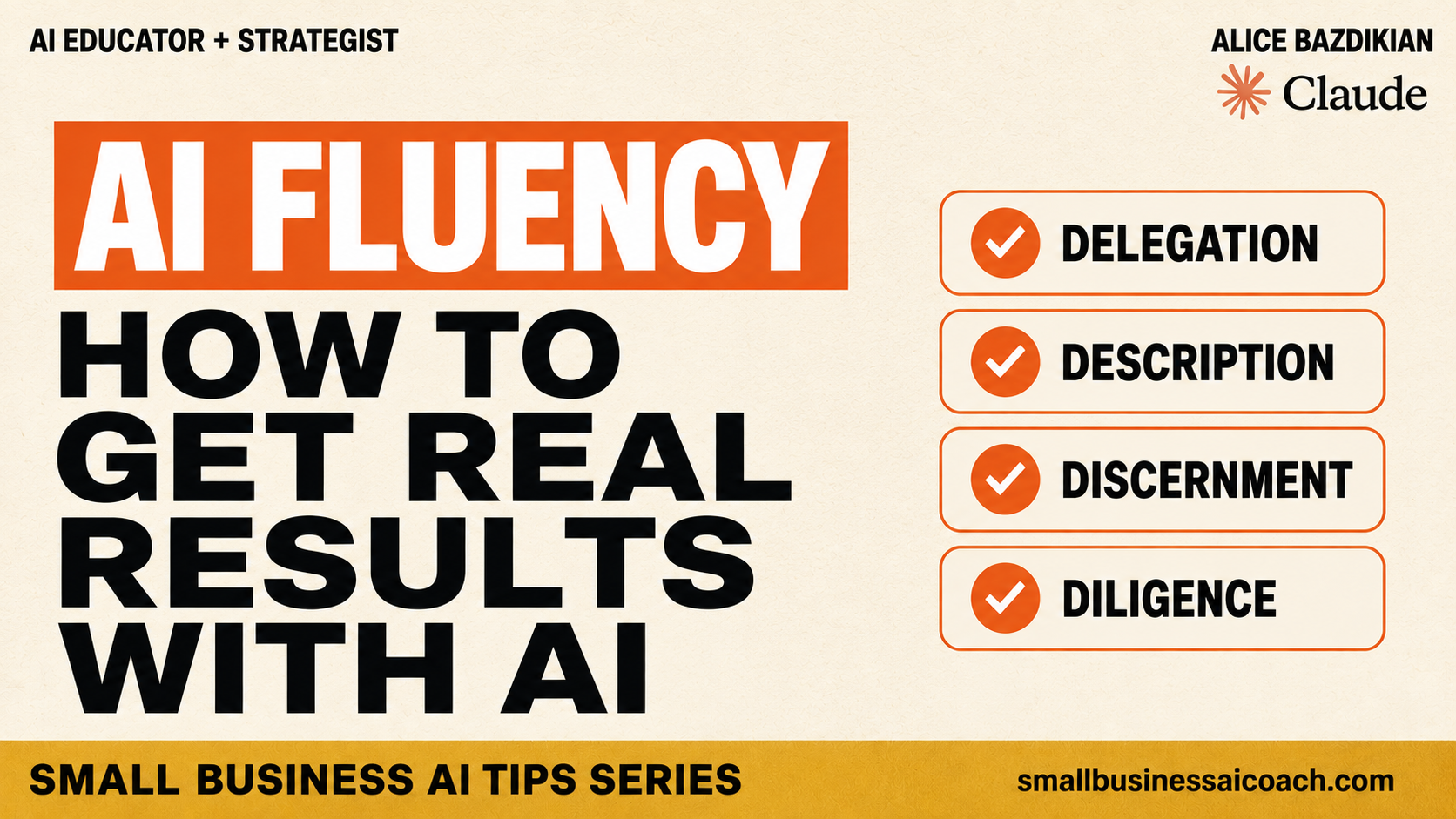
The other day I was sitting with a small business owner, watching him work in Claude and ChatGPT as we built a B2B sales list of contacts for his business. And as I watched him move between the two AIs, it hit me how much AI fluency decides whether you get real results from AI. Results that are reliable, useful, and actionable, instead of output you quietly redo yourself. The difference is not the tool, and it is not a secret prompt. It is a learnable skill.
Why this matters for your business
Every hour you spend redoing AI output that missed the point is an hour the tool was supposed to save you. But the real loss is bigger than the hour: every subpar output is a missed chance to save time and get a better result than you would have gotten without AI. That is what fluency unlocks. It is how you truly augment yourself with AI instead of trying to replace yourself with it. And here is the good news: it is a management skill, not a technical one. If you have ever trained an assistant or briefed a contractor, you already have the raw material.
How tomorrow gets better
Fluency is where AI's ROI actually lives. Small service businesses that take it seriously are reporting numbers like a painting contractor cutting administrative work by 35% in its first month, a catering company saving 15 hours a week on client intake while responding to clients 60% faster, and an agency owner who estimates one AI workflow saves an employee 15 hours of admin a week for about $12 in AI usage. None of that came from a magic prompt. It came from owners who delegate the right job, brief it well, judge the work, and own the result. That is the skill this article hands you.
The framework in this article is not something I invented. It comes from Anthropic, the company behind Claude, which developed it with academic researchers and teaches it as a free, self-paced course called AI Fluency: Framework and Foundations. The course teaches practical skills for AI interaction that is "effective, efficient, ethical, and safe." What follows is my translation for a non-technical service business owner: the four Ds, in plain English, with where each one shows up in a real week.
What AI Fluency Actually Is
"You do not need to become technical. You need to become a good manager of a very fast, very literal new hire."
AI fluency is the set of judgments you bring to working with AI: knowing which work to hand over, how to brief it, how to evaluate what comes back, and how to stay accountable for the result. It is how you augment what you already do well, instead of hoping AI replaces the need to think.
Read that list again and notice something. It is a management skill. Those are the exact judgments you already use with an assistant, a bookkeeper, or a contractor. If you have ever delegated work to a person and reviewed what came back, you are closer to AI fluent than most of the people posting prompt threads online.
The 4 Ds: Anthropic's Framework at a Glance
Anthropic organizes fluency into four competencies, all conveniently starting with D. Here they are in the order you use them on any real task.
Choosing what AI should do at all, and what stays yours. This happens before you type anything.
Communicating the job: what you want, how it should be done, and what good looks like.
Evaluating the output critically before you use it, the way a manager reviews a first draft.
Using AI responsibly: checking what goes out, being honest about how you work, protecting client data.
Delegation: Decide What AI Should Do at All
Delegation starts before you open a chat window. What is the actual problem you are solving? Is AI even the right tool for it? Which parts stay yours? Fluent owners ask these questions first, the same way they would before handing work to a new assistant.
The pattern that works: repeatable, describable work goes first. Drafting invoices, summarizing calls, turning one video into five posts, first-pass bookkeeping. My month-end routine with Claude is delegation in action: four repeating jobs I used to do by hand, each one describable enough that AI can carry it.
Just as important is what you do not delegate: your prices, your judgment about people, the final word on anything a client sees. Fluent delegation is not "hand everything over." It is knowing where the line sits in your business.
Description: Brief the Work Like You Mean It
Description is how you communicate the job. The course covers prompting techniques here, but you can think of it as something you already know how to write: a brief.
Vague brief in, generic work out. "Write a newsletter" gets you noise. "Write my weekly email to non-technical service owners, in my voice, around 300 words, one practical takeaway, no hype" gets you a draft you can actually use. The details you would give a freelancer are exactly the details AI needs: the audience, the format, the tone, and what a good result looks like.
Here is the small business shortcut most people miss: you should not have to give a good brief twice. Claude lets you write the brief down once and reuse it forever, as a skill. That is why I call skills the biggest unlock for owners. If the concept is new to you, start with what Claude skills are, then follow the walkthrough on how to build your first Claude skill. No code, about fifteen minutes.
Discernment: Judge the Work Before You Use It
Discernment is evaluating what comes back, and it is the D that separates the owners who get burned from the owners who compound. AI produces confident work. Confident is not the same as correct.
Judge AI output the way you would judge a new employee's first draft. Is the fact right? Is the number right? Does it actually sound like me? Would I send this as-is? In practice, description and discernment form a loop: you brief, you review, you tighten the brief, and the work gets better every round. The course calls it the description-discernment loop. Every good manager already knows it by its older name: feedback.
When you catch a mistake, do not just fix the output. Fix the instructions so the mistake cannot come back. In Claude, that means updating your skill file or its memory once, instead of correcting the same thing in every new chat.
Diligence: Own What Goes Out the Door
Diligence is the responsibility layer: using AI in ways that are safe, honest, and accountable. That can sound abstract, but for a small business it is refreshingly concrete.
| The rule | What it means in practice |
|---|---|
| Own the output | If AI drafts it and you send it, it is yours. Check names, numbers, dates, and promises before anything reaches a client. |
| Be honest | Never present AI research as verified fact, and never let it invent testimonials, statistics, or credentials for you. |
| Protect data | Client information goes into tools you trust, under privacy settings you have actually looked at. |
Diligence also starts on day one of setup, not after something goes wrong. Turning on the right instructions, memory, and privacy settings before you do anything else is half the job done: my Claude Desktop setup guide walks through exactly that, step by step.
Where to Start This Week
You do not become fluent by reading about fluency. Here is the one-week version:
- Take the free course. AI Fluency: Framework and Foundations is self-paced and plain-English, with a certificate at the end. An afternoon well spent.
- Pick one task you repeat every week and run the four Ds on it out loud: should AI do this, how would I brief it, how will I judge the result, and what do I check before it goes out?
- Set up your workspace properly, with instructions, memory, and privacy settings first. I walk through the whole thing on camera in the Claude Desktop setup video on my YouTube channel.
- Turn your best brief into a skill so you never have to re-type it. Here is how to build your first Claude skill.
- Bring what you built to my free Office Hours on Tuesday, and we will pressure-test your discernment together.
The tools will keep changing every quarter. The four judgments will not. That is the whole point of learning fluency instead of prompts: learn the judgments once, and every new model that ships makes you faster instead of more confused.
Come to my AI Office Hours next Tuesday, 12 to 1pm ET
There are no "wrong" questions. Bring whatever you are stuck on, and we work through it together, live. Free, no pitch.

Join the Small Biz AI Hub community
Real people, real support, real skills you can install. Free to join as a founding member for a limited time. Come build alongside other owners.